
Beyond the Mirage: How LLMs Actually Work — Frozen Weights, Harnesses, and Matrix Math
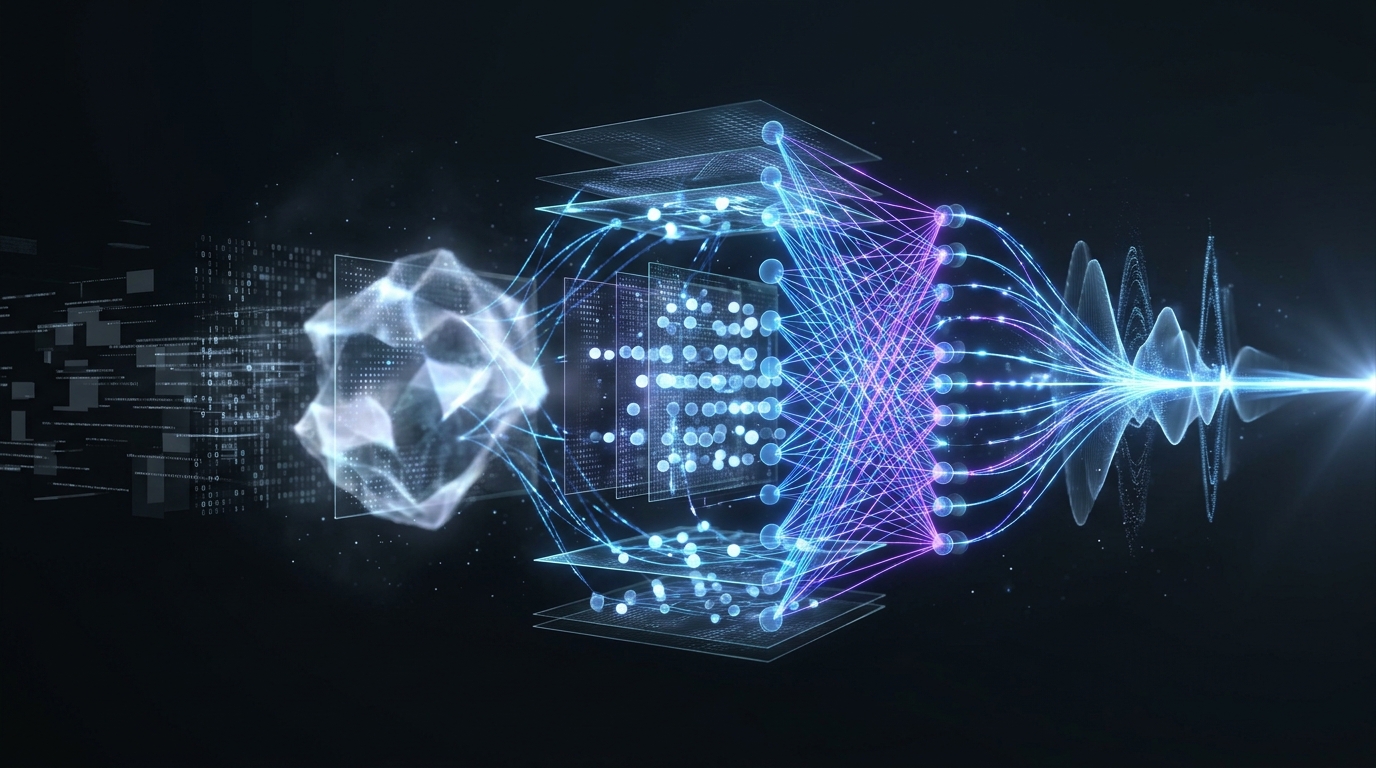
Few technologies in modern history have been obscured by as much anthropomorphic myth as the modern Large Language Model (LLM). Headlines routinely personify AI as thinking, feeling, or developing autonomous opinions, while users marvel at fluid conversational interfaces that appear genuinely conscious.
Yet if you strip away the polished frontends and marketing rhetoric, the physical reality is fundamentally different—and far more fascinating from an engineering standpoint.
An LLM possesses no consciousness, harbors no opinions, experiences no emotions, and makes no deliberate, willful choices. At its core, an LLM is a frozen, static mathematical artifact executed across billions of transistor switches.
Here is an architectural breakdown of how these systems truly function under the hood: why models are static, how advanced harnesses create the illusion of evolving cognition, and why every word spoken or written by an AI is ultimately the product of mathematical equations manipulating ones and zeros.
1. The Reality of the “Brain”: Frozen, Static Weight Matrices
One of the most persistent misconceptions about LLMs is the belief that they “learn” during your conversations.
They do not.
When a foundational model like Llama, Gemma, or GPT finishes its training run on a massive compute cluster, the resulting weights are serialized and saved to disk as immutable data files (such as .safetensors or .gguf archives). Those weights—hundreds of billions of floating-point numbers—are completely static:
- No On-the-Fly Learning: When an LLM generates a response on your screen, not a single weight parameter in the neural network is altered. The model that answers your hundredth question is bit-for-bit identical to the model that answered your first.
- No Inherent Continuity or Memory: The model has no persistent subconscious or continuous existence. The moment a token generation pass concludes, execution halts. It does not “think” between prompts.
- The Only Path to New Knowledge: An LLM cannot acquire new factual knowledge, unlearn obsolete data, or permanently correct mistakes on its own. For its fundamental parameters to change, engineers must manually curate new datasets and run compute-intensive fine-tuning, Reinforcement Learning from Human Feedback (RLHF), or full pre-training passes.
An LLM is not an evolving digital mind; it is an extraordinary mathematical lookup and projection engine, frozen in time at the exact moment its training checkpoint was saved.
2. Beneath the Words: Tokens, Linear Algebra, and Silicon Bits
A central truth of machine learning is that neural networks understand nothing about human language. They do not understand grammar, humor, sorrow, or logic. They process purely numerical tensors.
Every piece of interaction goes through a deep mechanical pipeline:
[ Human Text Input ]
        │
        ▼
[ Tokenizer: String -> Array of Token IDs (Integers) ]
        │
        ▼
[ Embedding Layer: Integer IDs -> High-Dimensional Vector Coordinates ]
        │
        ▼
[ Transformer Stack: Billions of Matrix Multiplications, Dot Products, Softmax ]
        │
        ▼
[ Probability Distribution Over Vocabulary Array ]
        │
        ▼
[ Output Token: Highest Probability Choice Sampled ]
- Tokenization & Embeddings: When you feed text into a model, a tokenizer cuts words and subwords into integer IDs (e.g.,
"developer"might become integer15832). The embedding layer translates each integer into a high-dimensional vector—a string of hundreds of floating-point numbers placing that concept into mathematical space relative to all other concepts. - Matrix Equations & Attention: These vectors pass through dozens of transformer layers. Each layer executes massive parallel matrix multiplications, scaling queries, keys, and values to compute self-attention weights. In essence, the network calculates: “Given the numerical coordinates of these previous tokens, which mathematical dimension should be emphasized next?”
- The Silicon Foundation (1s and 0s): Beneath the high-level Python libraries and CUDA kernels, these matrix equations are computed by hardware arithmetic logic units (ALUs) and Tensor Cores. Electrical voltages alternate between high and low states, flipping billions of logic gates. Ultimately, every nuanced sentence generated by an AI is calculated by flipping ones and zeros ($1$s and $0$s) in register files to solve linear algebra equations.
- The “Outcome”: The final layer does not output thought; it produces a logits vector—a probability distribution across the model’s fixed dictionary of tokens. The generation loop samples a token, appends it to the sequence, and repeats the entire calculation.
3. The Illusion of Voice: Audio Disguised as Thought
With the rise of “Voice Mode” across modern interfaces, the anthropomorphic illusion has peaked. A model that speaks with natural cadence, pauses to “breathe,” and modulates its tone sounds undeniably human.
Technically, however, the fundamental reality remains unchanged: the reasoning core remains bound to discrete numeric representations.
In conventional voice architectures, the core language model never actually “hears” or “speaks.” Instead, it is enveloped by companion satellite models:
- Automatic Speech Recognition (ASR / STT): A smaller, specialized audio model (such as Whisper or a Conformer network) samples the user’s analog audio stream, performs spectrogram analysis, and converts sound waves into a standard string of text tokens.
- The Core LLM: The central model receives plain text tokens from the companion model and computes a text response, completely unaware that the user spoke out loud.
- Text-to-Speech (TTS): Another specialized neural network synthesizes the generated text tokens into phonemes and renders realistic acoustic waveforms, injecting artificial pauses and inflections.
Even in modern native audio-to-audio multimodal models (such as Gemini Live or GPT-4o), audio waveforms are broken down into discrete acoustic codebook tokens. The neural network is still doing the exact same thing: multiplying mathematical matrices to predict the next numeric token in a sequence.
4. The Real Star of Modern AI: The Harness
If the language model itself is a frozen, passive calculation matrix, what makes ChatGPT, Claude, or Gemini feel like dynamic, proactive assistants?
The answer lies in the harness (the software framework, agent runtime, and web interface that encloses the model).
The raw weights of an LLM are largely unusable for end users. If you send raw text to a raw foundational base model, it will simply attempt to complete the document—often regurgitating web forum threads or programming syntax at random.
The harness is the sophisticated operating scaffolding that turns raw matrix multiplication into an interactive experience:
┌──────────────────────────────────────────────────────────────┐
│                       THE HARNESS                            │
│                                                              │
│  ┌───────────────────────┐        ┌───────────────────────┐  │
│  │ System Prompt Scaffolding │        │  Context & History    │  │
│  └───────────┬───────────┘        │     Buffer Window     │  │
│              │                    └───────────┬───────────┘  │
│              ▼                                ▼              │
│       ┌───────────────────────────────────────────────┐      │
│       │ Dynamic Prompt Assembly & Memory Synthesis    │      │
│       └──────────────────────┬────────────────────────┘      │
│                              │                               │
│  ┌───────────────────────────▼──────────────────────────┐    │
│  │                 RAW FROZEN MODEL CORE                │    │
│  │       (Matrix Operations & Probability Sampling)     │    │
│  └───────────────────────────┬──────────────────────────┘    │
│                              │                               │
│              ┌───────────────┴───────────────┐               │
│              ▼                               ▼               │
│  ┌───────────────────────┐        ┌───────────────────────┐  │
│  │ Tool / Function Calls │        │ Safety, Formatting &  │  │
│  │ (Search, Python Exec) │        │ Markdown Rendering    │  │
│  └───────────────────────┘        └───────────────────────┘  │
└──────────────────────────────────────────────────────────────┘
The harness is responsible for:
- Context Buffer Assembly (Simulated Memory): Because the model remembers nothing, the harness silently re-sends the entire past conversation history with every single new prompt, creating the illusion of a continuous memory stream.
- Tool Execution & Retrieval (RAG & Web Grounding): When an AI searches the web, executes Python code, or queries an API, the model isn’t browsing the internet. The harness detects a structured function call token emitted by the model, halts inference, executes the actual code on a backend container, appends the output to the prompt context, and triggers the model to continue generation.
- Safety Guardrails & Post-Processing: Scanning user inputs for malicious injection vectors, evaluating outputs against moderation classifiers, and formatting raw token streams into clean Markdown, code snippets, or streaming web responses.
5. The System Prompt: Directing the Probabilistic Actor
Inside the harness lies the single most influential lever governing model behavior: the System Prompt.
Before your prompt ever reaches the neural network, the harness prepends a hidden master directive into the context buffer. This system prompt establishes the persona, constraints, and instructions that dictate the model’s behavior:
“You are a helpful, concise software engineer. Maintain an objective tone, verify all code snippets, and never fabricate citations.”
How does a few lines of text transform a chaotic statistical distribution into an articulate, cooperative agent?
Because an LLM predicts the next most likely token based on all preceding context, injecting a system prompt fundamentally biases the probabilistic landscape:
- It heavily raises the mathematical probability of professional, empathetic, or analytical words while depressing colloquial, chaotic, or irrelevant vocabulary.
- It conditions the network to roleplay human interaction patterns—mirroring conversational manners, expressing faux gratitude, and acknowledging boundaries.
The model is not “deciding” to be polite or helpful. The system prompt simply places the model in a mathematical state where polite and helpful completions possess the highest statistical probability.
Conclusion: Respecting the Engineering Over the Illusion
It is easy to see why society gravitates toward romanticizing AI as nascent digital minds. Evolution hardwired human brains to perceive consciousness in anything that communicates using complex syntax and responsive dialog.
Yet the technical reality is far more impressive than any science-fiction fantasy:
- Without feelings, desires, or conscious awareness,
- Relying entirely on fixed, frozen weight checkpoints,
- Driven by harnesses that assemble history, route tools, and steer context,
- Executing pure matrix algebra over electronic binary states,
Modern computer science has succeeded in structuring high-dimensional mathematics to map the entirety of human language and reason through complex problems.
When we strip away the superstition and acknowledge that an LLM is a deterministic engine calculating probabilities through electrical transistor states, we stop fearing magical mirages—and start mastering the real power of modern computational tools.